Showing posts with label social networking. Show all posts

Wednesday, August 1, 2012

Everyone's doing it

Social technologies have been adopted at a faster rate than any other media technology, according to the McKinsey Global Institute.
While it took commercial television 13 years to reach 50 million households and Internet service providers three years to sign their 50 millionth subscriber, it took Facebook just a year to hit 50 million users. It took Twitter nine months.

In May 2012, Facebook logged its 900 millionth user. It is estimated that 80 percent of the world’s online population use social networks on a regular basis. In the United States, the share of total online time spent on social networking platforms more than doubled from January 2008 to January 2011, from 7 percent to 15 percent. Moreover, social technologies are replacing other Web applications and uses; use of e‑mail and instant messaging are off sharply in the past few years.
Today, more than 1.5 billion people around the globe have an account on a social networking site, and almost one in five online hours is spent on social networks— increasingly via mobile devices.
 Most of those folks are reading this blog. No wait, that's not true. I just made it up.

Tuesday, July 24, 2012

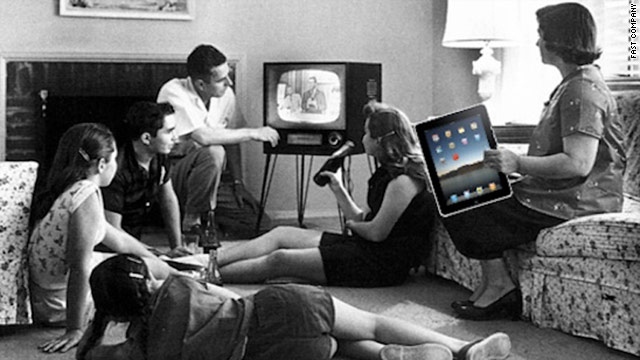
Are you a two-screener?


Early adopters.
My first hint of this was watching my son watch TV. He is arrayed on the couch in a position that might be described as a half-hearted attempt at a headstand. He's watching TV, doing something with his iPad, and texting friends on his phone.

If he had more hands he'd no doubt be working some other device.

This is what the information technology giant Tata Consultancy Services calls "the second screen" -- some other device in use while you're in front of the TV. Increasingly TV producers are trying to take advantage of this.
Tweeting while watching TV began this convergence once companies realized that people continued to use smartphones even while doing other things. This also involved going to other internet channels like YouTube to continue the experience they had on the first screen – the TV.
Networks such as The Discovery Channel are engaging in conversations with viewers and building a growing network of fans. With its vast assortment of networks, including the Animal Channel, the company manages 70 Facebook fan pages with 40-million fans and 20 Twitter accounts with 2.4 million followers. 
Wow. I thought they just showed films of cute deer eating leaves. Every now and then when I turn on an NCIS rerun to take my nap I see some sort of invitation inviting me to go online for something or other. Why would I do that?

The apps are out there, of course.
Some of the most popular apps include Miso and GetGlue. These sites provide an app that allows you to select the show of your choice and join the conversation with others in your network even if the show is not being aired currently. Both apps can be linked to your Facebook or Twitter community, allowing you the opportunity to interact with others who share a similar interest.
If I knew how to work my smart phone I might try it. Get this:
ABC was one of the first to try out the Second Screen with this experiment on its property My Generation, in 2010. This iPad app creates a seamless, two-screen, interactive television experience by bridging a cable / satellite connection and an iPad, by measuring analog sound waves using the iPad’s microphone. It looks for certain contours in the audio signal so that it knows when to display a particular poll or other item linking up with a precise moment in the show. This can also trigger ads or links on the Second Screen app, where an ad will be displayed on the primary screen first and then reveal more in depth content through the app.
But will it get up and fetch me some ice cream?

Wednesday, May 23, 2012

Say cheese


You look marvelous, darling!

Here's what Facebook and similar sites want from you: pictures.

In the online arms race between Apple, Facebook, Google, and others, control of the world’s snapshots is seen as vital – and lucrative, Quentin Fottrell writes. 
Pinterest, an online scrapbook that lets users share and comment on their favorite images, had over 20 million users in April, up from one million in July 2011. The startup just raised $100 million. Facebook, meanwhile, added to its image arsenal Monday, snapping up the London-based photo-sharing service Lightbox for an undisclosed fee. Apple too is upgrading its iCloud online service to include new photo-sharing features.
“Photos are the real currency for social networks,” says social psychologist Matt Wallaert. “We want to know, ‘What does she look like now? Who did she marry? How great is her life?’ They are much more revealing than reading a status update.” 
People share over 200 million photos on Facebook every day, or six billion per month. Larry Rosen, author of iDisorder: Understanding Our Obsession with Technology and Overcoming Its Hold on Us, says it makes people feel like trendsetters, photo-journalists and celebrities. “We’re presenting ourselves as stars,” he says. “That’s why fan magazines and reality shows are so compelling. This is the online equivalent.”
But there are other reasons.
  • Like bank accounts, photos are “sticky.” Whether they’re Facebook pictures of your Aunt Ida eating an ice-cream in Yellowstone Park or a random picture on Pinterest of patriotic candy, it’s difficult to move months or years of digital memories to a rival site. “The time and effort required to move those photos to some other type of digital storage is significant,” says Michelle Barnhart, assistant professor of marketing at Oregon State University College of Business. 
  • Aside from the images themselves, the location data and other personal information embedded in the files may also be lucrative to advertisers.
  • Endless photo posting by friends also keeps people trawling through albums and clicking, enabling sites to charge more to advertisers and generate revenue. 
And you thought it was just one big friendly place.

Monday, April 9, 2012

What Facebook knows about you

Peekaboo.
"Apps" are stylish, discrete chunks of software that live online or in your smartphone. To "buy" an app, all you have to do is click a button. Sometimes they cost a few dollars, but many apps are free, at least in monetary terms, Julia Angwin and Jeremy Singer-Vine write in The Wall Street Journal
You often pay in another way. Apps are gateways, and when you buy an app, there is a strong chance that you are supplying its developers with one of the most coveted commodities in today's economy: personal data.
Some of the most widely used apps on Facebook—the games, quizzes and sharing services that define the social-networking site and give it such appeal—are gathering volumes of personal information.
A Wall Street Journal examination of 100 of the most popular Facebook apps found that some seek the email addresses, current location and sexual preference, among other details, not only of app users but also of their Facebook friends. 
One Yahoo service powered by Facebook requests access to a person's religious and political leanings as a condition for using it. The popular Skype service for making online phone calls seeks the Facebook photos and birthdays of its users and their friends.
This appetite for personal data reflects a fundamental truth about Facebook and, by extension, the Internet economy as a whole: Facebook provides a free service that users pay for, in effect, by providing details about their lives, friendships, interests and activities. Facebook, in turn, uses that trove of information to attract advertisers, app makers and other business opportunities.
Capitalizing on personal data is a lucrative enterprise. Facebook is in the midst of planning for an initial public offering of its stock in May that could value the young company at more than $100 billion on the Nasdaq Stock Market.

Saturday, October 15, 2011

Facebook is really, really big

Facebook now has as many users as the entire Internet did back in 2004, the year Facebook was founded.

Facebook’s active user base is…
  • 2.5x the population of the United States
  • 3.9x the population of Brazil
  • 5.8x the population of Russia
  • 6.3x the population of Japan
Another fact: Facebook is bigger than a bread box.

Friday, March 18, 2011

How the Japanese people are communicating with each other

App for your smart phone.

When the earthquake hit northern Japan on Friday, voice calls from mobile phones became immediately unavailable in order to leave room for emergency calls, The Japan Times reports. However, in the Kanto area, mobile Internet connection was mostly kept on, and many people turned to the Web to exchange information.
On Japan's main social networking site, mixi, some communities were set up soon after the quake to keep people informed. The largest onenow has over 300,000 members and it has guides to communities by region and purpose.
Mixi also has a function that displays how recently your friends logged in, so you can check if your friends have accessed mixi after the quake. Another feature, ashiato (footprints) — which was once one of the key attractions to mixi — shows when another user viewed your page (profile/diary/message/etc). While it is possible to send messages to your most important family and friends, features that do not require any direct interaction meant that even those who are not close friends can see who is OK. 
Twitter was heavily used as well. When most railways stopped in greater Tokyo on Friday evening, many office workers were isolated in central Tokyo and decided to either stay put or walk back home. A lot of assistance was offered over Twitter by stores, restaurants, campuses and even people in houses along main roads who tweeted that help was available. Twitter even set some official hashtags to help identify your tweet, such as #jishin (general earthquake information); #j_j_helpme (requests for rescue or other aid); #hinan (evacuation information); #anpi (confirmation of safety of individuals, places, etc.); #311care (medical information for victims). And although it is not official, #jishin_e seems to be used for English, too.
Meantime, I've found another smartphone app for earthquakes.
Earthquake Lite, which is free for Apple or Android. (If you hate ads, buy the $2 iPhone version). The software displays global seismic activity in a nicely designed format, and offers lists of events that you can filter by location, magnitude and time. 
On Thursday, for instance, the app listed the afternoon’s most recent earthquakes, including nine significant tremors near Japan’s east coast, and one in western China. The map view lets you dial down to see the epicenter.

Thursday, November 18, 2010

The business end of social media

Eric Lefkofsky is worth some $750 million, it's estimated, which came from online companies he created. Lately he's been playing in the social media field. Consider:
Groupon is a social-coupon Web site that he bankrolled and started in 2008 — a venture that has been called the fastest-growing company ever. Groupon offers its followers a deal-of-the-day coupon, sponsored by a local business, that the followers are encouraged to share with their social networks. The local business gets customers, and Groupon takes a share of the coupon proceeds — a business model that has led to talk that Groupon, still privately owned, could be worth as much as $3 billion. 
Why social media?
"We think that the most disruptive business models will take advantage of that social graph over the next five to 10 years. Take travel as an example. You should be able to plan your entire trip online, invite your friends to come with you and even interact with other friends who have already been to that location. Those people will provide you with content that will augment your experience."
One idea involves hiring.
"Think about the way most companies currently hire. You post a job and then get blind résumés in response. This should be a social experience. If you took everyone and asked them to list everyone they knew, you could create an enormous social graph of several million people. There’s no reason to hire people that we can’t learn something about through some connection of our personal network. There’s no site today that takes advantage of the social graph in this way, yet."
Social networking looks less and less like a fad.

Wednesday, October 6, 2010

Wednesday, September 29, 2010

When you're trying to find someone

There's an app for that. A new company, Uncommon Projects, has created something called Marco.
The product, which is called Marco after the popular children’s game Marco Polo, works through text messages or an iPhone application. It allows two people to share their location with each other, and then helps them meet by offering directions to a meeting point.
Tarikh Korula, who came up with the idea, says the goal was to create a simple one-to-one connection that did not require logging in, a robust social network or broadcasting one’s location to everyone.
“Is it realistic to expect parents, partners and colleagues to adopt social networking services just to meet one another? There needs to be a simpler way to find someone and connect.” Mr. Korula said the service was “something my mom could use, something private instead of social, an experience that is always opt-in.”
I'm thinking this would work when Goodwyfe gets lost in the grocery store, which happens every time we go in together.
 

Sunday, September 12, 2010

A Facebook warning

Police in Nashua, NH, arrested three men who used Facebook to target and burglarize dozens of homes, looting between $100,000 and $200,000 worth of property and goods, Fox News reports.  

The two teenagers and a Massachusetts resident used sites like Facebook to find people who were on vacation or away from town -- and then targeted their homes. In addition to featuring status updates, Facebook includes a feature called Places, where users can check in to a specific location, notably one that isn't their house.

In February, a website gained notoriety for highlighting the risks of such actions. It's name: PleaseRobMe.com.

Tech News Daily has some guidance on using Facebook safely.
  • Do not include your home address in social networking profiles and set your general privacy settings to "Friends only".
  • The default setting in Facebook for check-ins is "Friends only" but because most Facebook users have friends that are really only acquaintances or connected loosely to other friends, it's important to customize this setting. Open the dropdown menu associated with "Places I check in" and select "Customize." Add friends whom you know and trust.
  • Next you'll need to adjust the "People Here Now" setting, because although you've limited your check-ins to specific people, anyone who checks in to a location where you have already checked in will see that you are there. Uncheck the box next to "Include me in 'People Here Now' after I check in."
  • Finally, consider blocking the ability for friends to check you into a location to avoid practical jokes or worse. Go to the "Things others share" section, select the dropdown box associated with "Friends can check me in to Places" and select "Disabled."

Monday, August 23, 2010

Where are you?

Facebook has launched a new feature called Places that helps mobile phone users broadcast their whereabouts and track their friends: They can see who else 'checked into' a museum, shop, park or theater, what they did there and what they thought of it.
Facebook's Silicon Valley rival Google Inc. has already staked a claim with its own location service and is in the process of building a social networking service to compete with Facebook rumored to be called Google Me. Both companies are keenly pursuing the potentially lucrative location-based market, which remains largely up for grabs.
Advertisers are eager to target consumers based on their location by sending coupons or special offers to people near specific stores, bars, movie theaters and restaurants. That mobile advertising market could grow to $3 billion by 2014, up from $200 million this year, the consulting firm Borrell Associates predicts. But checking in has not yet become mainstream. Forrester Research reports that only 4% of adults in the United States use location services.
Beware: Places is far better in terms of protecting user privacy than previous new feature roll outs such as the Instant Personalization service launched in April. Nevertheless, Places can still reveal important data about you if you don't take the time to adjust your privacy settings.

If you're not convinced that posting your location can be a bad thing, check out PleaseRobMe for some evidence.

Details on how to protect yourself here.