Tuesday, April 3, 2012

Do you understand 4G? I don't.

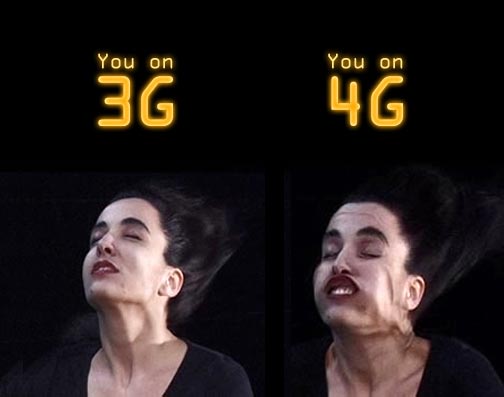
Weird photo.
Luckily for us, Walter Mossberg, the Wall Street Journal's astute technology columnist, does. Here's his take.

AT&T claims "The nation's largest 4G network," and T-Mobile says it has "America's largest 4G network." Verizon Wireless boasts "America's fastest 4G network," and Sprint says it had the first 4G network, Mossberg notes.
Yet the technology used by T-Mobile, and mostly comprising AT&T's 4G network, isn't considered "real" 4G at all by some critics, and the one used by Sprint has proven to be a dead end and is being abandoned. The flavor being used by Verizon is now being adopted by its rivals, but won't be interoperable among them.
Got that? Let's continue.
4G is the fourth and latest generation technology for data access over cellular networks. It's faster and can give networks more capacity than the 3G networks still on most phones. There's a technical definition, set by a United Nations agency in Europe, and a marketing definition, which is looser, but more relevant to most consumers. It's mostly for people with smartphones, tablets and laptops who often need fast data speeds for Web browsing, app use and email when they're out of the range of Wi-Fi networks.
Okay, we're going to get technical here, so you might want to cover your eyes as you read.
LTE, which stands for "Long Term Evolution," is the fastest, most consistent variety of 4G, and the one most technical experts feel hews most closely to the technical standard set by the U.N. In the U.S., it has primarily been deployed by Verizon, which offers it in over 200 markets. AT&T has begun deploying it, offering LTE in 28 markets so far. Sprint and T-Mobile are pivoting to LTE, though they have no cities covered by it yet. 
Sprint uses a technology called WiMax. T-Mobile and AT&T deployed a technology called HSPA+, a faster version of 3G that they relabeled as 4G, and which many technical critics regard as a "faux 4G." Sprint will begin switching to LTE later this year, and T-Mobile in 2013.
Got that? So, you ask, what?
Although it is wireless, LTE is often faster than most Americans' wired home Internet service. According to Akamai, a large Internet company, the average broadband speed in the U.S. in the third quarter of 2011 was a mere 6.1 mbps.

Wi-Fi is usually a wireless broadcast of a wired Internet service, so, if the average U.S. broadband speed is 6.1 mbps, that's around what the average Wi-Fi speed is. But, in public places, the shared Wi-Fi is often much, much slower than LTE.
So who has the biggest 4G network in the U.S.?
Even if you accept all the carriers' definitions of 4G, it's hard to tell. Carriers measure the size of their networks differently—sometimes by the number of people to whom it is theoretically available, and sometimes by the number of cities and markets, which can be defined differently. Verizon has the largest LTE network. Both AT&T and T-Mobile claim the biggest 4G network, but the first has only a limited LTE deployment and the second has none.
There you go, boys and girls. I have solved this problem by sticking with 3G, which I don't understand, and which provides all the juice I need, since I don't understand how to use my smartphone anyway.

Saturday, March 31, 2012

Defending the Internet

Today is anything but a normal Saturday for the people who run the Domain Name System, which converts human-friendly domain names like google.com into numeric addresses that are more useful for computers, The New York Times reports.
They plan to be glued to their monitors, looking out for signs of unusual network traffic, communicating with one other through encrypted, digitally signed e-mails or through a private telephone hot line maintained just for this purpose.
That's because on a quiet Sunday in mid-February, something curious attracted the attention of the behind-the-scenes engineers who scour the Internet for signs of trouble.
There, among the ubiquitous boasts posted by the hacking collective Anonymous, was a call to attack some of the network’s most crucial parts. The message called it Operation Global Blackout, and rallied Anonymous supporters worldwide.
It declared when the attack would be carried out: March 31. And it detailed exactly how: by bombarding the Domain Name System with junk traffic in an effort to overwhelm it altogether.

Engineers created a fast-track, multimillion-dollar global effort to beef up the Domain Name System, adding enough computing power to handle a denial of service attack.

Personally, I think they wanted to shut down this blog.

Tuesday, March 20, 2012

Don't lose your phone


Perp.
According to a new study, if you lose your smart phone, you have a 50/50 chance of getting it back. But chances are much higher – nearly 100 percent – that whoever retrieves it will try to access your private information and apps.
According to a study by Symantec, 96 percent of people who picked up the lost phones tried to access personal or business data on the device. In 45 percent of cases, people tried to access the corporate email client on the device.
Symantec called the study the “Honey Stick Project.” In this case the honey on a stick consisted of 50 smartphones that were intentionally left in New York, Los Angeles, Washington, D.C., San Francisco and Ottowa, Canada. The phones were deposited in spots that were easy to see, and where it would be plausible for someone to forget them, including food courts and public restrooms.
Each phone also was loaded with programs to track what finders did with the devices, and to send that information to the researchers. Among people who found the phones, 72 percent tried to access photos, 57 percent tried to open a file called “Saved Passwords,” and 43 percent tried to open an app called “Online Banking.” 
Most of the apps on the phones were protected by passwords, but the username and password fields were already filled out, so that users could simply press a button to access them. Well over half of the people who discovered the phones, 66 percent, clicked those buttons to try and start the programs. The fact that the finders had to click a button to access the apps indicates that their attempts were likely intentional.
You should know that if you pick up and try to use my phone it will explode, spewing biotoxins and chemicals that will eat your flesh and make your eyeballs burst.

Wednesday, March 14, 2012

A sign of the times


After 244 years, the Encyclopaedia Britannica is going out of print.
Those coolly authoritative, gold-lettered reference books that were once sold door-to-door by a fleet of traveling salesmen and displayed as proud fixtures in American homes will be discontinued, company executives said. 
In an acknowledgment of the realities of the digital age — and of competition from the Web site Wikipedia — Encyclopaedia Britannica will focus primarily on its online encyclopedias and educational curriculum for schools. The last print version is the 32-volume 2010 edition, which weighs 129 pounds and includes new entries on global warming and the Human Genome Project. 
“It’s a rite of passage in this new era,” Jorge Cauz, the president of Encyclopaedia Britannica Inc., a company based in Chicago, said in an interview. “Some people will feel sad about it and nostalgic about it. But we have a better tool now. The Web site is continuously updated, it’s much more expansive and it has multimedia.”
Gutenberg first used moveable type 573 years ago. The World Wide Web opened for business 21 years ago. I got all of this post from the Web. You will read it on the Web.

Thursday, December 22, 2011

The light of day


Think you're smarter than me?

One of the little-noted provisions in that legislation floating around Washington -- it has to do with payroll tax cuts and an oil pipeline -- is a suspension of the ban on 100-watt lightbulbs.

I've been stocking up on these babies, because I hate these new CFL bulbs. It's like we're back in pioneer days living by candlelight.

Well, here's an inside look at who gets what in all this mess. Just read it all.
When Republicans suspended the 100-watt-light-bulb ban, they said they were trying to protect consumer choice. But they also managed to show how regulations help big business at the expense of the little guy. 
The light-bulb ban was part of an energy bill pushed by Democrats in 2007 that set efficiency standards that traditional incandescent bulbs could never meet. The first to go was supposed to be the 100 watt bulb in 2012, followed by 75 watt bulbs the next year and the ubiquitous 60-watt bulb in 2014. 
The argument is that forcing consumers to buy more efficient — and far more expensive — bulbs will greatly reduce energy consumption, and in turn, air pollution and global warming.
Earlier this month, Republicans suspended the law until October by denying funds for its implementation as part of a massive spending bill. For Democrats, this move was another sign of how out of touch the GOP is. 
But look who else is complaining. As Politico reported, "big companies like General Electric, Philips and Osram Sylvania (are) fuming." Allegedly these companies are mad because they invested lots of money getting ready for the new rules.
Fact is, they were pushing for the ban all along. 
In 2007, Philips urged an incandescent ban as a way to force the market toward high-efficiency bulbs, complaining that without such laws, "purchase price and functional performance often take precedence over environmental concern." 
That same year, the National Electrical Manufacturers Association, which represents companies making 95% of bulbs sold in the U.S., told a Senate panel that a ban was needed "to further educate consumers on the benefits of energy-efficient products."
You can believe if you want these companies only had Mother Earth in mind with this ban. But more likely they saw it as a chance to fatten their bottom lines. Who wouldn't jump at the chance to outlaw a low-margin, 60-cent product when you're trying to hawk a high-margin $3 alternative? 
This would hardly be the first time big business teamed up with big government to enhance profits through competition-crushing regulations. Timothy Carney's book, "The Big Ripoff," detailed many cases where businesses "profit from big government policies that rip off consumers." 
Thanks to the GOP, consumers now can see this seedy process at work, clear as day.
Journalism -- we bring good things to light.

Sunday, December 18, 2011

So is talking and driving unsafe or what?

Don't do this, either.
A federal agency is calling for a nationwide ban on all cellphone use while driving, Investor's Business Daily reports. The National Transportation Safety Board recommended that all cellphone use by drivers, including texting, be outlawed. The ban would include hands-free calls.
There are a few problems here. 
There's no compelling reason for it. The National Highway Traffic Safety Administration says that 3,092 traffic deaths last year involved distracted drivers. But using a cell phone is only one of many driver distractions. Eating and drinking while behind the wheel are two others, and they are far more dangerous than yapping on a phone. 
In fact, a 2009 NHTSA study found that 80% of all car wrecks are caused by drivers eating or drinking — not cellphone use — with coffee-guzzling the top offender. 
Then there's this. According to federal data, traffic deaths have fallen from 2.1 per 100 million vehicle miles in 1990, when virtually no one had a cellphone, to 1.1 in 2009, when almost everyone does.
The newspaper asks: Banning cellphone use? Why aren't the Potomac nannies going after Starbucks sippers and Big Mac munchers instead? Why not prosecute women who put on their makeup while on the road and men who shave? Shouldn't combing while driving be outlawed as well?

Righto. Flossing, too. Nose-picking. Reading Proust.

Saturday, December 17, 2011

One way to control the cost of healthcare


More than 3,000 people in England with diabetes, heart failure or COPD (a serious lung disease called chronic obstructive pulmonary disease) took part in a recent two-year trial of telehealth technology for monitoring people who are chronically ill.
According to the results of the trial, published by the Department of Health, telehealth can reduce mortality, reduce the need for admissions to hospital, lower the number of days spent in a hospital bed and cut the time spent in A&E.
Here's how it works.
First thing in the morning, Terry Munro always puts the kettle on. "Then I take my blood sugar, take my blood pressure and my weight and in that time the kettle's boiled.
"And I've got a record of it on my TV. It's marvellous, it really is." 
Terry, who is 67 years old and has diabetes, has been keeping tabs on his own health using nothing more than his television. The testing equipment uses Bluetooth so when Terry has taken his daily measurements they are automatically uploaded to the TV. 
A trained nurse can access and monitor the readings from a central location and make decisions about potential changes in treatments. "I like walking, but I used to go out and go hypo. Now I know I can't go out if my blood sugar is too low, so I am more aware now. 
"It's like having a doctor there all the time."

Patients like Terry are constantly being watched by nurses, albeit at a distance. Any unusual readings entered onto the TV are picked up straight away and will prompt a visit by a nurse or an alert to the patient's doctor.

Wednesday, November 23, 2011

12345!


Imperva, a security company, has made some suggestions to NASA about passwords to they can protect their secrets about alien space invaders.

Here's what they recommend:
  • It should contain at least eight characters
  • It should contain a mix of four different types of characters - upper case letters, lower case letters, numbers, and special characters such as !@#$%^&*,;" 
  • If there is only one letter or special character, it should not be either the first or last character in the password.
  • It should not be a name, a slang word, or any word in the dictionary. It should not include any part of your name or your e-mail address.
Following that advice, of course, means you'll create a password that will be impossible, unless you try a trick credited to security guru Bruce Schneir: Turn a sentence into a password.
For example, "Now I lay me down to sleep" might become nilmDOWN2s, a 10-character password that won't be found in any dictionary. 
Can't remember that password? Schneir says it's OK to write it down and put it in your wallet, or better yet keep a hint in your wallet. Just don't also include a list of the sites and services that password works with. Try to use a different password on every service, but if you can't do that, at least develop a set of passwords that you use at different sites.
Last year, Imperva looked at 32 million passwords stolen from RockYou, a hacked website, and released its own Top 10 "worst" list:
1. 123456
2. 12345
3. 123456789
4. Password
5. iloveyou
6. princess
7. rockyou
8. 1234567
9. 12345678
10. abc123
Tech company Splashdata also compiled a list of the worst:
1. password
2. 123456
3.12345678
4. qwerty
5. abc123
6. monkey
7. 1234567
8. letmein
9. trustno1
10. dragon
11. baseball
12. 111111
13. iloveyou
14. master
15. sunshine
16. ashley
17. bailey
18. passw0rd
19. shadow
20. 123123
21. 654321
22. superman
23. qazwsx
24. michael
25. football
My recommendation, on advice from the Gumbo Blog High Tech Security Division, is that you create one giant password out of those lists. This will also help you develop your memory.

Saturday, October 15, 2011

Facebook is really, really big

Facebook now has as many users as the entire Internet did back in 2004, the year Facebook was founded.

Facebook’s active user base is…
  • 2.5x the population of the United States
  • 3.9x the population of Brazil
  • 5.8x the population of Russia
  • 6.3x the population of Japan
Another fact: Facebook is bigger than a bread box.

Tuesday, October 4, 2011

Make your own stuff

Designer shoes.
Rick Chin, director of product innovation at SolidWorks, where he develops new products, says two technologies will transform they way we get new stuff.
Computer-aided design (CAD) products are popular among engineers, designers and students for creating 3D product designs. But the software is often too advanced for the average consumer to design his or her own products.

In the future, however, CAD will allow the average consumer to design his own custom products that are both manufacturable and affordable. Consumers will be able to use simple software to combine predefined, configured product features. They’ll be able to personalize further by adding their own color palate, pictures, shapes and even personalized sizing.
Add another technology, and things really get fun.
3D Printing (3DP) is another amazing technology that will take a 3D CAD model and “print” layers of material, one on top of the previous, to produce a real physical model. It can create almost any shape, even those that can’t be made by traditional manufacturing. The downside today is that the process is slow, costly, and often doesn’t produce parts strong enough for real world use. The technology in this industry is always advancing, and in the future, it will be able to produce robust parts quickly and cheaply.

3D Printing in an industrial setting is often referred to as “additive manufacturing.” As products are ordered online, versatile manufacturing stations controlled by robots will quickly and affordably crank out custom-manufactured products. The robots will be controlled by process software that will be integrated with future CAD.
Online custom products are slowly gaining popularity.
You can go to NIKEiD and design your own customized Nike shoes. The downside is that they are pricey and will take several weeks to get to you. Other websites such as ShapeWays and Ponoko are useful for many DIYers. The mass market appeal of sites like these will grow in the future (when combined with the simpler CAD described above) with fast, flexible and inexpensive manufacturing.
Think I'll design me a nap.