Saturday, March 26, 2011

Toss those cookbooks

I've been going through the business throwing stuff away. Seems I've saved every telephone I've ever owned. There are three computer printers down there. And more books than the Library of Congress. What to keep?

An article in the New York Times has some advice, including this on books.
Keep them (with one exception). Yes, e-readers are amazing, and yes, they will probably become a more dominant reading platform over time, but consider this about a book: It has a terrific, high-resolution display. It is pretty durable; you could get it a little wet and all would not be lost. It has tremendous battery life. It is often inexpensive enough that, if you misplaced it, you would not be too upset. You can even borrow them free at sites called libraries. 
But there is one area where printed matter is going to give way to digital content: cookbooks. Martha Stewart Makes Cookies a $5 app for the iPad, is the wave of the future. Every recipe has a photo of the dish (something far too expensive for many printed cookbooks). 
Complicated procedures can be explained by an embedded video. When something needs to be timed, there’s a digital timer built right into the recipe. You can e-mail yourself the ingredients list to take to the grocery store. The app does what cookbooks cannot, providing a better version of everything that came before it.
Now all Martha has to do is make a decorative splashguard for a tablet and you will be all set.

Friday, March 18, 2011

How the Japanese people are communicating with each other

App for your smart phone.

When the earthquake hit northern Japan on Friday, voice calls from mobile phones became immediately unavailable in order to leave room for emergency calls, The Japan Times reports. However, in the Kanto area, mobile Internet connection was mostly kept on, and many people turned to the Web to exchange information.
On Japan's main social networking site, mixi, some communities were set up soon after the quake to keep people informed. The largest onenow has over 300,000 members and it has guides to communities by region and purpose.
Mixi also has a function that displays how recently your friends logged in, so you can check if your friends have accessed mixi after the quake. Another feature, ashiato (footprints) — which was once one of the key attractions to mixi — shows when another user viewed your page (profile/diary/message/etc). While it is possible to send messages to your most important family and friends, features that do not require any direct interaction meant that even those who are not close friends can see who is OK. 
Twitter was heavily used as well. When most railways stopped in greater Tokyo on Friday evening, many office workers were isolated in central Tokyo and decided to either stay put or walk back home. A lot of assistance was offered over Twitter by stores, restaurants, campuses and even people in houses along main roads who tweeted that help was available. Twitter even set some official hashtags to help identify your tweet, such as #jishin (general earthquake information); #j_j_helpme (requests for rescue or other aid); #hinan (evacuation information); #anpi (confirmation of safety of individuals, places, etc.); #311care (medical information for victims). And although it is not official, #jishin_e seems to be used for English, too.
Meantime, I've found another smartphone app for earthquakes.
Earthquake Lite, which is free for Apple or Android. (If you hate ads, buy the $2 iPhone version). The software displays global seismic activity in a nicely designed format, and offers lists of events that you can filter by location, magnitude and time. 
On Thursday, for instance, the app listed the afternoon’s most recent earthquakes, including nine significant tremors near Japan’s east coast, and one in western China. The map view lets you dial down to see the epicenter.

Wednesday, March 16, 2011

Where to get real-time news on Japan

I consider myself fairly sophisticated about the news, but it's hard to sort out the rapidly changing situation in Japan. Curt Hopkins at the blog ReadWriteWeb has compiled some sources of real-time news about the crisis.

@timeouttokyo The Twitter account for the Tokyo version of the weekly entertainment and event guide is focusing a lot on what's happening and what residents and visitors should do, reflecting the focus of their website.

@survivinginjapan Ashley, a Seattlite teacher and writer in Shizuoka, usually gives out expat advice. These days that advice is more urgent.

@ambassadorroos John Roos has been the U.S. ambassador to Japan since 2009. A good source for information on official U.S. actions, such as the Marines delivering a Forward Arming and Refueling Point for use in the assistance operations.

@Matt_Alt Writer Matt Alt's tweets are more analytical, giving some background into the actions of Japanese press, politicians and industry.

NHK English The English channel of Japan's most prominent television network provides text and video news updates from all over Japan.

Crisis Commons. The crisis network has put together a Honshu Quake wiki.

Donating. Rick has pulled together four excellent resources for those wishing to donate.

Ushahidi Crowd-sourced crisis map on the Ushahidi platform. (In Japanese.)

Google Person Finder Google's released a Japanese version of their people-finding service for anyone having difficulties getting a hold of family and friends. The Red Cross has their own, called Family Links.

WNYC News and explainers regarding the Fukushima nuclear plant from the New York-based public radio station.

Tuesday, March 15, 2011

Your laptop can detect an earthquake

Yikes!

If you drop your laptop computer, a chip built into it will sense the acceleration and protect the delicate moving parts of its hard disk before it hits the ground. Researchers are putting the chip to work detecting earthquakes with a network of volunteer laptops that can map out quakes in far greater detail than traditional seismometers.

I can't determine whether smart phones can be used on this particular network, the Quake-Catcher Network. But I found this one: the iShake Project.

With the Quake-Catcher program, a laptop monitors local activity and only alerts the network for strong new signals. If the network's central server receives a bunch of these all at once, then it is likely that an earthquake is happening. If the server receives a notification from only one laptop, it knows the laptop was shaken by something smaller and more local (like your sister running by, or the door slamming).

You can check all of this out, and sign up, here.

Monday, March 14, 2011

Disaster: there's an app for that

New app saves the day.

It has always seemed to me that these smart phones everyone is carrying around these days can do more than tell your friends you're eating a bacon cheeseburger at Cardiac Shack.

I found an article, via Instapundit, that points to a few apps that seem interesting. One is a manual of advice for all sorts of disasters. The iPhone version, the Droid version.

Another is a first aid manual from the American Heart Association. For iPhone, for Droid.

And an emergency radio scanner: for iPhone, for Droid. Those link to the pro version, but there's a free one as well. Might be fun when you're watching a rerun of Law & Order.

While you cower in your storm shelter, you can always connect to the source of all life here.

Monday, March 7, 2011

Your TV is watching you

He's watching you.

I had no idea this was going on.
Data-gathering firms and technology companies are aggressively matching people's TV-viewing behavior with other personal data—in some cases, prescription-drug records obtained from insurers—and using it to help advertisers buy ads targeted to shows watched by certain kinds of people. 
At the same time, cable and satellite companies are testing and deploying new systems designed to show households highly targeted ads. 
One of the most advanced companies, Cablevision Systems Corp., has rolled out a system that can show entirely different commercials, in real time, to different households tuned to the same program. It can deliver targeted ads to all the company's three million subscribers concentrated in New York, Connecticut and New Jersey.
Darn. The Wall Street Journal article says my cable company, Comcast, isn't doing this yet. I was hoping it explained why, when I'm simply trying to watch a Law & Order rerun from 1996 to lull me to sleep, I'm bombarded with GEICO ads. I prefer ads for the slap chopper and sham-wow, stuff relevant to my lifestyle.

Saturday, March 5, 2011

Buy now, or wait for the new version?

She's got all the answers.
I just bought a Motorola Droid X phone, and I know something better will come along in a few weeks, if it's not already out there.

And folks who got an iPad for Christmas are probably wishing they had waited.

So I noticed the Best Buy ad saying the company will sell you that gadget you just have to have and then buy it back when the newer version comes along.

What's the catch?

Joshua Gans, an economics professor at Melbourne Business School and a visiting researcher at Microsoft Research, writes in a Harvard Business Review blog (you wanted my opinion?):
Here's how it works. If you pay $59.99 to Best Buy, you can make sure that you get a certain amount back if you want to upgrade your iPhone later. For instance, if you want to buy in a year's time, Best Buy will pay you 40% of the price of your old phone. Let's do some math. Pay $299 originally and you get around $120 back. So if the new model costs the same amount, then you will effectively pay $180 to upgrade (I'm ignoring sales tax here). Of course, you actually paid $359 originally so the automatic upgrade price is really $240 but perhaps you feel better about it at the time or in explaining the credit card bills to your spouse.
It took me a minute to parse that. You have to figure that the first $59.99 reflected a contract commitment, and the $240 you'd pay for the new phone doesn't give you the contract commitment deal.

But that's not even the real issue.
The choice is not between paying Best Buy more, twice, or paying them slightly less. You could do what I did last year. I put my old iPhone on eBay. That cost me a little time but it netted me much more than 40% of the phone's purchase price. Indeed, in my case, I received 100% of that price because the phone was free of a contract. For items in good condition, eBay really allows you to do well on the second-hand market. Forecast that and you can see that Best Buy is costing you a fortune.
He goes through a lot more stuff only an economist could love, and you're welcome to read it, but I think we all see why we just buy something impulsively, as I did. You can't have your own personal economist following you around in Best Buy, or Costco, where I bought my phone.

And as Gans sums up: For doubters out there considering whether you should get yourself an iPhone now or wait, here is my simple statement that I have used to sell a ton of iPhones: "No one is going to be sitting on their death bed saying, "'I wish I had waited to buy an iPhone.'"

Sunday, February 27, 2011

Your health in digits

This could be you!
I've long believed that one answer to our healthcare mess is digital health records. I look at my family doctor's office, and I see mounds of paper, a half dozen clerks frantically shuffling them, and a wall of manilla folders holding the health histories of hundreds of people.

Above all this is a fire sprinkler. Not at all reassuring.

Last year I went to an eye surgeon who was introducing digital records to his practice. As I watched from the chair, he and his assistant labored at a laptop to enter my data into the many fields of my record.

Right there we see the problems. There's not a lot of money lying around in family practices. Given the absence of standards, why should my doctor invest in something that may be outdated next year? And given all the upcoming changes in the government's role, how could anyone make a rational decision? And as my eye surgeon demonstrated, it's not as simple as it seems.

Digitalization makes a lot of sense. Each year there are tens of thousands of phone calls from pharmacists to physicians to clarify prescriptions. I've experience this. Throw out the little paper pads, type it into a gizmo hanging on your belt and off it goes to the pharmacy. Plus, the gizmo could warn both about drug interactions and the like.

The government has got it in its head (oxymoron alert!) that it's going to push everyone to a digital world.
In the 2009 economic recovery package, the administration and Congress allocated billions — the current estimate is $27 billion — in incentives for doctors and hospitals to adopt electronic records. 
Late last year, the administration, working with health professionals and the technology industry, set out a roadmap for what digital records should include and how they should be used, for doctors to qualify for incentive payments, typically up to $44,000. The program begins this year, and the requirements for using the records to report and share health information increase in stages through 2015. After that, penalty payments from Medicare and Medicaid kick in for doctors who don’t meet the use and reporting rules.
Carrot and stick. We'll see how that works out.

Wednesday, February 23, 2011

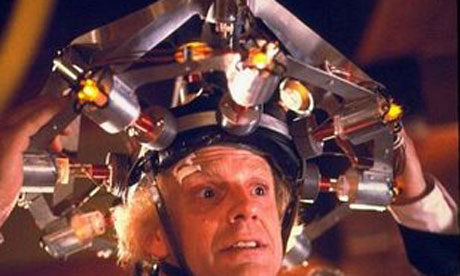
This is your brain on electricity

"Yes, Midge, I'm dying."

Whether cell phones hurt our brains -- and I'm not talking about the effects of chatting with your idiotic friends or having your boss find you on Saturday -- has been debated for years. A new study adds to the clamor:
Researchers from the National Institutes of Health have found that less than an hour of cellphone use can speed up brain activity in the area closest to the phone antenna, raising new questions about the health effects of low levels of radiation emitted from cellphones. 
The researchers urged caution in interpreting the findings, because it is not known whether the changes, which were seen in brain scans, have any meaningful effect on a person’s overall health.
As with the health effects of coffee, I urge you to remain calm: pour a cup and call a friend to talk this over.

The leader of the research, Dr. Nora D. Volkow, director of the National Institute on Drug Abuse, said:
“Unfortunately this particular study does not enlighten us in terms of whether this is detrimental or if it could even be beneficial. It just tells us that even though these are weak signals, the human brain is activated by them."
Dr. Volkow said future research may even show that the electromagnetic waves emitted from cellphones could be used to stimulate the brain for therapeutic reasons.
She said the research should not set off alarms about cellphone use because simple precautions like using a headset or earpiece can alleviate any concern. 
“It does not in any way preclude or decrease my cellphone utilization,” she said.
Never trust headlines: you have to read to the end of the New York Times article to get that.

"Hey, I have an idea!"
Meantime, we get this:
New scientific research suggests that by stimulating parts of their brains electrically, people can be induced to think more creatively than they normally do.  
The researchers took 60 normal, healthy, right-handed volunteers and asked them to try to solve a task that required clever insight. All of them were told they'd be receiving some kind of brain stimulation. But just 20% of the control group (who received no stimulation) could solve the task. That's compared with 60% of the volunteers who received electrical jolts to their brain--cathode stimulation of the left ATL (anterior temporal lobe) to suppress activity and anodal stimulation of the right ATL to increase activity.
Shocking.

Tuesday, February 22, 2011

Are you smarter than your laptop?

Smarter than me!
Imagine a world in which millions of farmers in China can access most of human knowledge with devices they carry in their pockets.

Oops! That's true today.

Imagine a world in which your laptop has the power of Watson, the IBM super computer that emerged the victor against human competitors on "Jeopardy!".

Not far away, says Ray Kurzweil, the inventor and futurist.
The ratio of computer price to performance is now doubling in less than a year, so 90 servers would become the equivalent of one server in about seven years, and the equivalent of one personal computer within a decade. However, with the growth in cloud computing—in which supercomputer capability is increasingly available to anyone via the Internet—Watson-like capability will actually be available to you much sooner. 
Given this, I expect Watson-like "natural language processing" (the ability to "understand" ordinary English) to show up in Google, Bing and other search engines over the next five years.
"Jeopardy!", Kurzweil writes, involves understanding complexities of humor, puns, metaphors, analogies, ironies and other subtleties.

That's something I can't do today.