Monday, March 7, 2011

Your TV is watching you

He's watching you.

I had no idea this was going on.
Data-gathering firms and technology companies are aggressively matching people's TV-viewing behavior with other personal data—in some cases, prescription-drug records obtained from insurers—and using it to help advertisers buy ads targeted to shows watched by certain kinds of people. 
At the same time, cable and satellite companies are testing and deploying new systems designed to show households highly targeted ads. 
One of the most advanced companies, Cablevision Systems Corp., has rolled out a system that can show entirely different commercials, in real time, to different households tuned to the same program. It can deliver targeted ads to all the company's three million subscribers concentrated in New York, Connecticut and New Jersey.
Darn. The Wall Street Journal article says my cable company, Comcast, isn't doing this yet. I was hoping it explained why, when I'm simply trying to watch a Law & Order rerun from 1996 to lull me to sleep, I'm bombarded with GEICO ads. I prefer ads for the slap chopper and sham-wow, stuff relevant to my lifestyle.

Saturday, March 5, 2011

Buy now, or wait for the new version?

She's got all the answers.
I just bought a Motorola Droid X phone, and I know something better will come along in a few weeks, if it's not already out there.

And folks who got an iPad for Christmas are probably wishing they had waited.

So I noticed the Best Buy ad saying the company will sell you that gadget you just have to have and then buy it back when the newer version comes along.

What's the catch?

Joshua Gans, an economics professor at Melbourne Business School and a visiting researcher at Microsoft Research, writes in a Harvard Business Review blog (you wanted my opinion?):
Here's how it works. If you pay $59.99 to Best Buy, you can make sure that you get a certain amount back if you want to upgrade your iPhone later. For instance, if you want to buy in a year's time, Best Buy will pay you 40% of the price of your old phone. Let's do some math. Pay $299 originally and you get around $120 back. So if the new model costs the same amount, then you will effectively pay $180 to upgrade (I'm ignoring sales tax here). Of course, you actually paid $359 originally so the automatic upgrade price is really $240 but perhaps you feel better about it at the time or in explaining the credit card bills to your spouse.
It took me a minute to parse that. You have to figure that the first $59.99 reflected a contract commitment, and the $240 you'd pay for the new phone doesn't give you the contract commitment deal.

But that's not even the real issue.
The choice is not between paying Best Buy more, twice, or paying them slightly less. You could do what I did last year. I put my old iPhone on eBay. That cost me a little time but it netted me much more than 40% of the phone's purchase price. Indeed, in my case, I received 100% of that price because the phone was free of a contract. For items in good condition, eBay really allows you to do well on the second-hand market. Forecast that and you can see that Best Buy is costing you a fortune.
He goes through a lot more stuff only an economist could love, and you're welcome to read it, but I think we all see why we just buy something impulsively, as I did. You can't have your own personal economist following you around in Best Buy, or Costco, where I bought my phone.

And as Gans sums up: For doubters out there considering whether you should get yourself an iPhone now or wait, here is my simple statement that I have used to sell a ton of iPhones: "No one is going to be sitting on their death bed saying, "'I wish I had waited to buy an iPhone.'"

Sunday, February 27, 2011

Your health in digits

This could be you!
I've long believed that one answer to our healthcare mess is digital health records. I look at my family doctor's office, and I see mounds of paper, a half dozen clerks frantically shuffling them, and a wall of manilla folders holding the health histories of hundreds of people.

Above all this is a fire sprinkler. Not at all reassuring.

Last year I went to an eye surgeon who was introducing digital records to his practice. As I watched from the chair, he and his assistant labored at a laptop to enter my data into the many fields of my record.

Right there we see the problems. There's not a lot of money lying around in family practices. Given the absence of standards, why should my doctor invest in something that may be outdated next year? And given all the upcoming changes in the government's role, how could anyone make a rational decision? And as my eye surgeon demonstrated, it's not as simple as it seems.

Digitalization makes a lot of sense. Each year there are tens of thousands of phone calls from pharmacists to physicians to clarify prescriptions. I've experience this. Throw out the little paper pads, type it into a gizmo hanging on your belt and off it goes to the pharmacy. Plus, the gizmo could warn both about drug interactions and the like.

The government has got it in its head (oxymoron alert!) that it's going to push everyone to a digital world.
In the 2009 economic recovery package, the administration and Congress allocated billions — the current estimate is $27 billion — in incentives for doctors and hospitals to adopt electronic records. 
Late last year, the administration, working with health professionals and the technology industry, set out a roadmap for what digital records should include and how they should be used, for doctors to qualify for incentive payments, typically up to $44,000. The program begins this year, and the requirements for using the records to report and share health information increase in stages through 2015. After that, penalty payments from Medicare and Medicaid kick in for doctors who don’t meet the use and reporting rules.
Carrot and stick. We'll see how that works out.

Wednesday, February 23, 2011

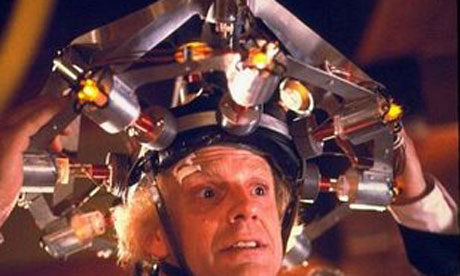
This is your brain on electricity

"Yes, Midge, I'm dying."

Whether cell phones hurt our brains -- and I'm not talking about the effects of chatting with your idiotic friends or having your boss find you on Saturday -- has been debated for years. A new study adds to the clamor:
Researchers from the National Institutes of Health have found that less than an hour of cellphone use can speed up brain activity in the area closest to the phone antenna, raising new questions about the health effects of low levels of radiation emitted from cellphones. 
The researchers urged caution in interpreting the findings, because it is not known whether the changes, which were seen in brain scans, have any meaningful effect on a person’s overall health.
As with the health effects of coffee, I urge you to remain calm: pour a cup and call a friend to talk this over.

The leader of the research, Dr. Nora D. Volkow, director of the National Institute on Drug Abuse, said:
“Unfortunately this particular study does not enlighten us in terms of whether this is detrimental or if it could even be beneficial. It just tells us that even though these are weak signals, the human brain is activated by them."
Dr. Volkow said future research may even show that the electromagnetic waves emitted from cellphones could be used to stimulate the brain for therapeutic reasons.
She said the research should not set off alarms about cellphone use because simple precautions like using a headset or earpiece can alleviate any concern. 
“It does not in any way preclude or decrease my cellphone utilization,” she said.
Never trust headlines: you have to read to the end of the New York Times article to get that.

"Hey, I have an idea!"
Meantime, we get this:
New scientific research suggests that by stimulating parts of their brains electrically, people can be induced to think more creatively than they normally do.  
The researchers took 60 normal, healthy, right-handed volunteers and asked them to try to solve a task that required clever insight. All of them were told they'd be receiving some kind of brain stimulation. But just 20% of the control group (who received no stimulation) could solve the task. That's compared with 60% of the volunteers who received electrical jolts to their brain--cathode stimulation of the left ATL (anterior temporal lobe) to suppress activity and anodal stimulation of the right ATL to increase activity.
Shocking.

Tuesday, February 22, 2011

Are you smarter than your laptop?

Smarter than me!
Imagine a world in which millions of farmers in China can access most of human knowledge with devices they carry in their pockets.

Oops! That's true today.

Imagine a world in which your laptop has the power of Watson, the IBM super computer that emerged the victor against human competitors on "Jeopardy!".

Not far away, says Ray Kurzweil, the inventor and futurist.
The ratio of computer price to performance is now doubling in less than a year, so 90 servers would become the equivalent of one server in about seven years, and the equivalent of one personal computer within a decade. However, with the growth in cloud computing—in which supercomputer capability is increasingly available to anyone via the Internet—Watson-like capability will actually be available to you much sooner. 
Given this, I expect Watson-like "natural language processing" (the ability to "understand" ordinary English) to show up in Google, Bing and other search engines over the next five years.
"Jeopardy!", Kurzweil writes, involves understanding complexities of humor, puns, metaphors, analogies, ironies and other subtleties.

That's something I can't do today.

Thursday, February 10, 2011

Those little lights that glow in the dark

You can get interested in this if you feel a personal responsibility for saving the planet, or if you feel a personal responsibility for not going broke.

We know the big energy hogs are refrigerators and ovens and the like, but consider this:
Digital picture frames are small, so it's hard to think of them as energy hogs. But if each U.S. household had one of these frames running around the clock, it would take five power plants to run them all, says the Electric Power Research Institute (EPRI), an electricity-focused research and development nonprofit.
It gets worse:
Other small energy hogs include mobile phone chargers and laptop power adapters that are always plugged in to electric outlets. These chargers continue to draw energy even when the devices they charge have been disconnected. And "always-on" appliances like printers or speakers are called "energy vampires" because they also suck up power even when they're turned off or in an idle state.
I had no idea. I thought the fact that various rooms are lit up at night by the little lights on gadgets was entertaining for the dog and cats. I didn't know I was paying for it.

Here are some other fun facts from Forbes:
  • The typical home has 30 always-on devices.
  • While a refrigerator  accounts for about 8% of a household's energy consumption, "vampire devices" account for about 4%.
  • It's estimated that estimates that gaming consoles consume around 16 billion kilowatt-hours per year, roughly the same energy usage as the city of San Diego.
  • Chargers for mobile devices like cellphones and PDAs use only 7 to 10 watts. But if they are left plugged in to electric outlets even when the charged device is not connected, they continue to draw power. Add them all up across the country, and they could consume the energy output of several power plants.
My pets will just have to get around in the dark.

Monday, February 7, 2011

Some facts about passwords

Most-used passwords: 123456, password, 12345678, qwerty, abc123

Time it takes a hacker's computer to randomly guess your password:
 
Length: 6 characters
Lowercase: 10 minutes
+ Uppercase: 10 hours
+ Nos. & Symbols: 18 days

Length: 7 characters
Lowercase: 4 hours
+ Uppercase: 23 days
+ Nos. & Symbols: 4 years

Length: 8 characters
Lowercase: 4 days
+ Uppercase: 3 years
+ Nos. & Symbols: 463 years

Length: 9 characters
Lowercase: 4 months
+ Uppercase: 178 years
+ Nos. & Symbols: 44,530 years

-- Bloomberg Businessweek

Sunday, February 6, 2011

Safer driving from cars that gossip with each other

Imagine that your car could learn from an oncoming car that the road ahead is icy or closed by an accident. That technology is now being designed and debated.
Many researchers believe we’re about to enter a new phase in transportation safety. If the last 50 years were about mitigating crashes, in the next 50, technology could enable us to actually avoid them — and revolutionize in the process how we get around using all types of transportation.
The vision is that millions of vehicles on the road will “talk to each other” through a kind of advanced Wi-Fi and this could potentially address 81 percent of the light-vehicle crashes currently involving unimpaired drivers.
The new technology would rely on Dedicated Short-Range Communications, a wireless connection with a 1-mile radius that is both faster and more secure than traditional Wi-Fi.

Vehicles with the technology could communicate with each other in real time about everything from upcoming icy roads to approaching vehicles in a driver’s blind spot. Emergency responders could be notified the moment an airbag deploys.

Instead of waiting to learn about a distant accident through the chain-reaction of brake lights illuminated in front of you, your car could automatically warn you the moment a nearby crash occurs (the system would not, however, push the brakes for you).
No word yet on whether this technology will side with your wife and force you to pull over and ask for directions.

Thursday, February 3, 2011

Choosing between iPhones at Verizon and AT&T

I watch everyone using their smart phones, particular their iPhones, and I'm thinking I need one of those. Especially now that Verizon will be selling the iPhone. I switched from AT&T to Verizon several years ago, because AT&T's service wasn't reliable where I live.

Except I really don't need one. And the cost is rather staggering.

Popular Mechanics sums it up: Over the course of a two-year contract, the total cost of AT&T's service (not including the cost of the phone) ranges from $1320 to $2760 (assuming you don't incur overages). Verizon's plans range from $1680 to $3360 (more expensive, for sure, yet with the unlimited plan, the potential for overage fees is seriously diminished).

There are a couple of differences between Verizon and AT&T.
  • First, the CDMA technology that Verizon uses will not allow users to talk on the phone and use data services at the same time. 
  • Second, AT&T's GSM iPhone works in other countries (albeit with steep international roaming fees), while Verizon's does not. 
So I guess if you're in Paris wanting to talk to Mom back home in Schenectady and simultaneously look up the weather forecast there, you're out of luck with Verizon. Darn.

Walter Mossberg, the Wall Street Journal personal technology columnist, concludes: In my tests, the new Verizon version of the iPhone did much better at voice calling than the AT&T version, and offers some attractive benefits, like unlimited data and a wireless hot-spot capability. But if you really care about data speed, or travel overseas, and AT&T service is tolerable in your area, you may want to stick with AT&T.

Tuesday, February 1, 2011

Using technology when your flight is canceled

Most carriers automatically notify travelers — at least those who have signed up for flight alerts by e-mail, text message or phone call, The New York Times reports. Those alerts, which many passengers fail to sign up for, combined with Twitter, can put you ahead of the pack.
Increasingly airlines, including JetBlue, Southwest and Delta, are using Twitter to notify passengers of major flight cancellations and assist in rebooking. Last year, Delta created a dedicated Twitter account for customer service issues, @DeltaAssist, with reservation agents online Monday through Friday from 8 a.m. to 9:30 p.m. Eastern time.
Because of the viral nature of Twitter, with Twitterers habitually “re-tweeting” one another’s posts, customers who reach out to the airline via Twitter may get a quicker response than they would by phone or another communications channel as airlines attempt to quell any negative publicity.